Topia Horizon is here.
    Get early access
    Topia

    Remote work compliance

    Remote work compliance software

    Remote work compliance software tracks where your employees are actually working and flags the tax, payroll and immigration obligations that follow them. It replaces informal approvals and spreadsheets with a structured process: a request, an automated risk check, a documented decision.If your people work across state lines or borders, those obligations already exist. The question is whether you can see them before they cost you.

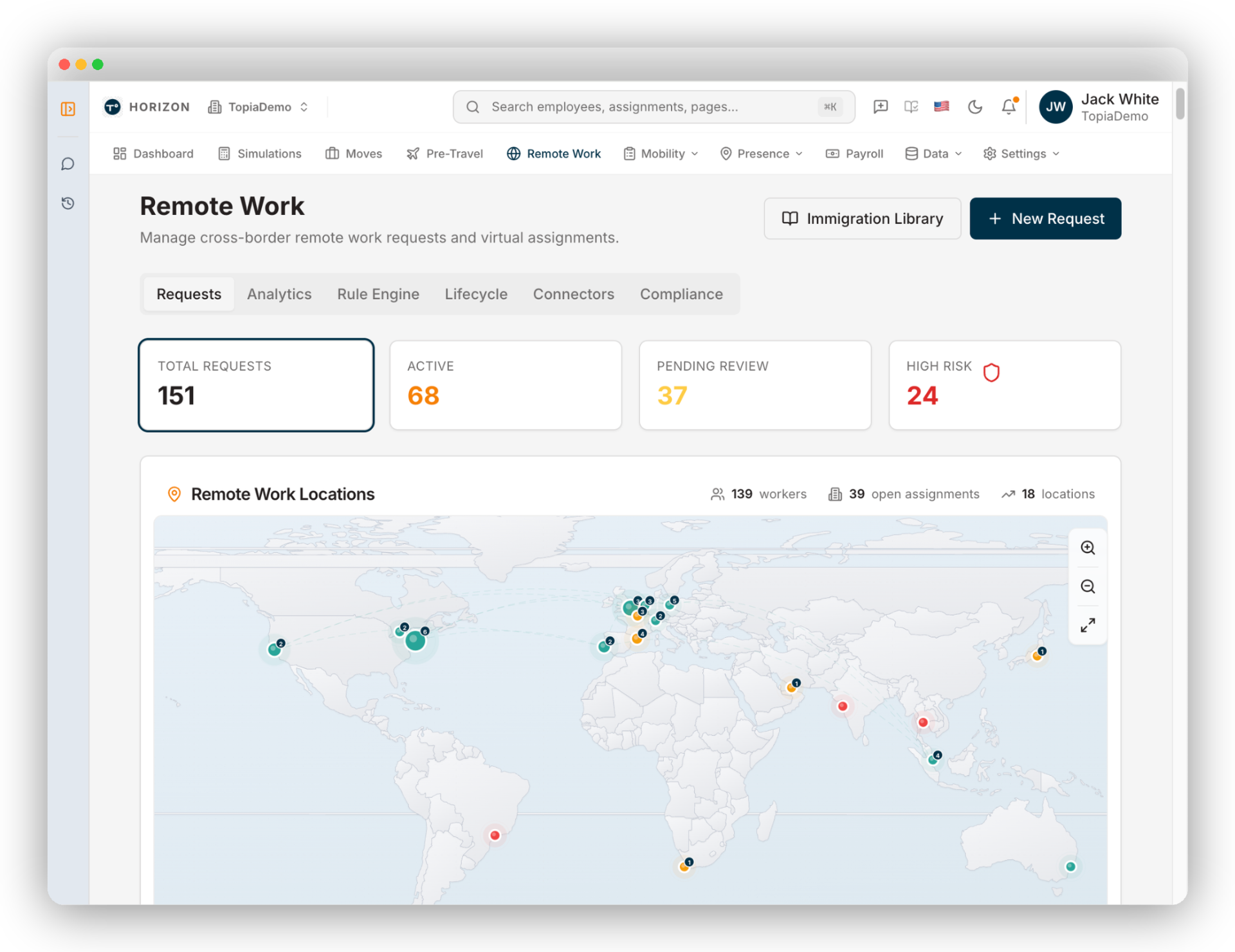
    Remote work compliance dashboard showing employee work locations worldwide
    Work-location visibility
    Where people are working, not where they are based.
    Screening before approval
    Risk checked at the point of request.
    Defensible audit trail
    Every request, assessment and decision on record.
    What it covers

    What remote work compliance actually covers

    Remote work creates four distinct categories of obligation. Most companies track none of them systematically.

    Corporate tax and permanent establishment

    An employee working from another country can create a taxable presence for your company in that country. Thresholds vary, and they are often lower than people expect. Once triggered, the exposure is retrospective. 84% of mobility teams lack visibility into employee work locations. (Source: AI Inflection Point report)
    Employment tax and payroll

    Work location determines where income tax and social security are owed. This applies between US states as much as between countries. Obligations can arise from a single day count crossing a threshold.

    Immigration and right to work

    Working while on a tourist visa is a common and expensive mistake. Right-to-work status, permitted activities, and Schengen day counts all need checking before travel, not after.

    Duty of care and data

    You are responsible for employees wherever they work. That includes knowing where they are, and understanding which data protection regime applies to the work they do there.

    Manual vs software

    Most companies manage this manually. It does not scale.

    Manual

    Manual

    Manual

    • Requests arrive by email or chat.
    • Approval depends on who is asked.
    • Risk is discovered after the employee has arrived.
    • No record links decisions to policy.
    • Different employees get different answers.
    • Nobody can say where the workforce is working today.

    With software

    Software

    With software

    • 1Requests arrive through one structured intake.
    • 2Screening runs before any decision.
    • 3Policy is applied by the system, not interpreted per reviewer.
    • 4Every decision is logged with a timestamp and an approver.
    • 5Location data is current, not annual.
    What to look for

    What to look for in remote work compliance software

    Six capabilities separate a system of record from a spreadsheet with extra steps.

    Work-location visibility

    Can you see where every employee is working right now, not where their contract says they are based?

    Screening before approval

    Does the risk check run before the decision, or does it produce a report afterwards?

    Policy enforced by the system

    Are your rules applied consistently by software, or interpreted differently by each reviewer?

    A defensible audit trail

    If a tax authority asks in three years, can you show the request, the assessment, the approver and the date?

    Coverage that matches your footprint

    Does the tax and immigration content cover the countries and states your people actually work in?

    Connections to what you already run

    Does it read from your HR, payroll and travel systems, or does it ask you to replace them?

    How it works

    How remote work compliance software works.

    1

    Request

    The employee submits a location, dates and a reason through a structured form rather than a message.

    2

    Screen

    The system checks the request against tax thresholds, immigration rules and your own policy before anyone approves it.

    3

    Decide

    Reviewers see the risk assessment alongside the request and approve, decline, or adjust the terms.

    4

    Monitor

    Approved arrangements are tracked against their limits, so you know before a threshold is crossed rather than after.

    What automation changes

    What automation changes.

    Screening before the decision

    Checks run at the point of request, so the answer can still change.

    Threshold tracking

    Day counts and duration limits are monitored continuously rather than reviewed at year end.

    Consistent policy application

    The same rules produce the same answer regardless of who reviews the request.

    A defensible record

    Every request, assessment and approval is retained with attribution, ready if a tax authority asks.

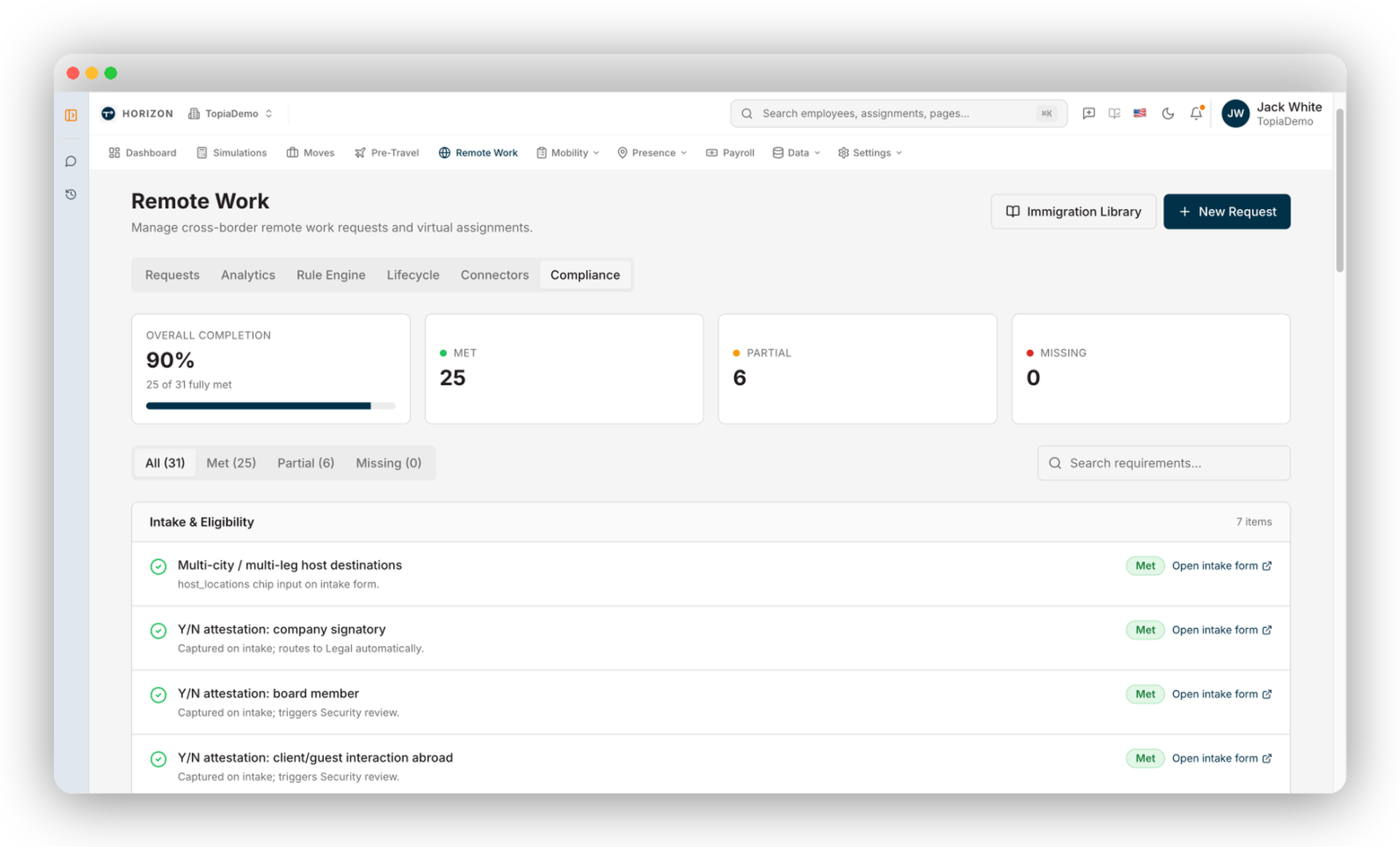
    Remote work request and screening workflow preview
    One system

    Remote work is one type of movement, not a separate problem

    The same compliance questions apply whenever someone works somewhere new. Horizon treats them as one system.

    Remote work

    Work-from-anywhere requests, hybrid arrangements, distributed teams

    Business travel

    Cross-border trips, day counting, pre-travel risk checks

    Relocations

    Permanent moves and assignments, cost modeling, document generation

    Visa and immigration

    Right to work, permits, permitted activities, expiry tracking

    Who needs this

    Who needs visibility into work location.

    Risk and compliance

    Know which obligations exist before they are triggered, not during an audit.

    HR

    Give employees a consistent answer on flexibility without creating legal exposure.

    Mobility

    Replace manual case handling with a process that runs itself for straightforward requests.

    Finance

    Understand the tax and payroll consequences of work location while decisions are still reversible.

    FAQs

    Remote work compliance questions

    What is remote work compliance software?

    Software that tracks where employees are working and identifies the tax, payroll, immigration and duty-of-care obligations created by those locations. It typically combines a request and approval workflow, automated risk screening, and an audit trail.

    How is it different from an Employer of Record?

    An EOR employs people on your behalf in countries where you have no legal entity. Remote work compliance software does not employ anyone. It tells you which obligations a work location creates, applies your policy to the request, and records the decision. Companies often use both, for different problems.

    What is permanent establishment risk?

    Permanent establishment is when an employee's activity in a country creates a taxable corporate presence there. It can be triggered by the type of work, its duration, or the employee's authority to conclude contracts. The consequence is corporate tax liability in a country where you did not intend to have one.

    Does this apply if employees only move between US states?

    Yes. State income tax, unemployment insurance and state nexus rules all follow work location. Multi-state payroll obligations are one of the most common exposures, and one of the easiest to miss because no border is crossed.

    When does a remote work request create a tax obligation?

    It depends on the jurisdiction, the duration, the employee's role and whether your company already has a presence there. Thresholds differ by country and by state, which is why the check needs to run against current rules at the point of request rather than from a static list.

    Can compliance checks run before a request is approved?

    Yes, and that is the point. Screening after approval tells you what went wrong. Screening before approval lets you change the answer, shorten the trip, or route it for specialist review.

    Ready when you are

    See where your people are working.

    Book a 30-minute demo. We will show you how Horizon surfaces work-location risk before it becomes a liability.